
World court rules Myanmar committed genocide against the Rohingya — a first for a state
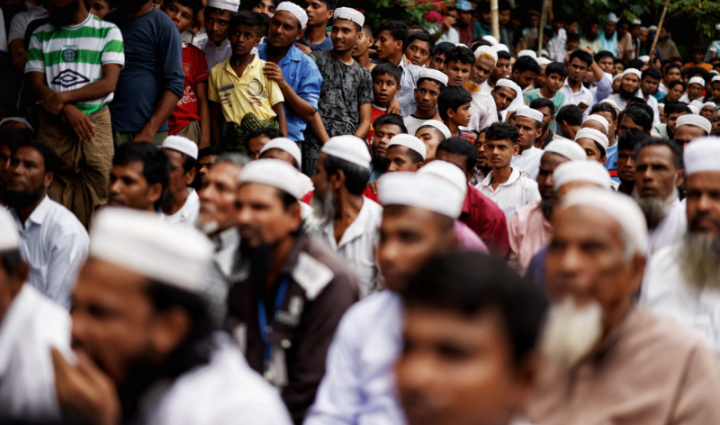 Photo: Mohammad Ponir Hossain / Reuters
The United Nations' highest court ruled Thursday that Myanmar committed genocide against the Rohingya during a brutal 2017 military crackdown, the first time the court has ever held a state responsible for the crime. The 15-judge panel voted 9-6, and ordered Myanmar to pay reparations and allow the people driven from their homes to return.
International Court of Justice President Yuji Iwasawa read the 191-page judgment in a packed Great Hall of Justice at the Peace Palace in The Hague, finding that Myanmar "has committed genocide against the Rohingya group in northern Rakhine state, in violation of its obligations under the Genocide Convention."
"The court finds that Myanmar's security forces killed thousands of Rohingya civilians, perpetrated widespread acts of sexual violence as well as acts of extreme violence against children and attacked fleeing Rohingya," Iwasawa said as he delivered the ruling.
The court found that Myanmar's military carried out mass executions of men and boys, committed widespread rape and sexual violence against Rohingya women, and burned or razed hundreds of villages during what it called "clearance operations" in northern Rakhine State in 2017. The judges adopted a United Nations fact-finding mission's figure of at least 10,000 deaths, saying it was supported by the record, and concluded that "the only reasonable inference that can explain Myanmar's actions is an intention to destroy a substantial part of the protected group" — the Rohingya of northern Rakhine.
The violence drove more than 700,000 Rohingya across the border into Bangladesh. Today roughly 1.2 million Rohingya live in exile in the sprawling Cox's Bazar refugee settlement, where more than 1,000 people cheered Thursday as the verdict was read out on a television screen.
"For decades, the Burmese military tried to erase our identity, deny our existence, and dismiss our suffering," said Wai Wai Nu, executive director of the Women's Peace Network and a former political prisoner. "By finding that Myanmar committed genocide, ordering a guarantee of non-repetition, and ordering restitution and compensation, the world's highest court has permanently shattered that state-sponsored lie."
The case was brought by The Gambia in November 2019, with the backing of the 57-member Organization of Islamic Cooperation. The court ordered emergency protective measures in January 2020, rejected Myanmar's objections to its jurisdiction in July 2022, and heard the merits of the case over three weeks in January 2026. Eleven states intervened in the proceedings, including Canada, France, Germany, the Netherlands and the United Kingdom.
The court rejected Myanmar's defense that the 2017 campaign was a legitimate operation against insurgents. It also found that Myanmar failed to prevent and punish genocide, failed to enact legislation giving full effect to the Genocide Convention, and violated the court's 2020 order to preserve evidence related to the allegations.
Along with the genocide finding, the court ordered Myanmar to investigate and, where warranted, prosecute people reasonably suspected of the crimes; to give assurances and guarantees that the violations will not be repeated; and to adopt measures of restitution, including allowing the "safe, voluntary and dignified return" of displaced Rohingya to their homes and the reunification of families separated by the violence. The amount of compensation will be decided in a later phase of the proceedings, and Myanmar must report back to the court within two years on the steps it has taken.
The ruling is final and binding, and cannot be appealed. But the court has no way to enforce it beyond reporting noncompliance to the U.N. Security Council, and it remains to be seen how much of the judgment can be put into practice. Myanmar's government, which has long denied genocide, did not immediately respond to the ruling. Britain said Thursday it was expelling Myanmar's defense attache and would set out further action in coming days.
Gambia's justice minister, Dawda Jallow, called the decision "a historic day for international justice." U.N. Secretary-General António Guterres welcomed the ruling, and rights groups said it would shape how states are judged under the 1948 Genocide Convention for years to come.
Genocide has rarely been established in international courts, largely because prosecutors must prove a specific intent to destroy, in whole or in part, a national, ethnic, racial or religious group. Thursday's decision was only the fourth time since the Nazi Holocaust that an international court has ruled the legal threshold for genocide was met — after Rwanda in 1994, the 1995 Srebrenica killings in Bosnia, and the atrocities of Cambodia's Khmer Rouge in the late 1970s. It was the first time the court held a state, rather than individuals, responsible.
The judgment is also expected to be closely studied in the court's other genocide cases, including South Africa's 2023 case accusing Israel of genocide in Gaza, which Israel denies, and cases linked to the war in Ukraine. The International Court of Justice settles disputes between states and rules on alleged breaches of international treaties; it is distinct from the International Criminal Court, which prosecutes individuals.
For the Rohingya in Cox's Bazar, the ruling does not by itself end their exile. "After losing everything, the Rohingya face struggles the court cannot solve," said Sayed Ullah, a community representative speaking from the camp, "but the decision will strengthen our efforts to return home."
Sources: The Associated Press, "For the first time, UN's highest court finds a country responsible for genocide: Myanmar" (Nov. 19, 2026, full text verified); Reuters, "Top UN court finds Myanmar committed genocide against Muslim Rohingya" (Nov. 19, 2026, full text verified) and "Reactions as top UN court finds Myanmar guilty of genocide against Rohingya" (Nov. 19, 2026, full text verified); Le Monde, "Rohingya: Historic International Court of Justice ruling finds Myanmar guilty of genocide" (Nov. 19, 2026, full text verified); United Nations Independent Investigative Mechanism for Myanmar, "ICJ – The Gambia v. Myanmar" (Nov. 19, 2026, full text verified); United Nations Office of the High Commissioner for Human Rights, "'Called by its true name': UN expert welcomes ICJ genocide verdict on Myanmar" (Nov. 19, 2026, full text verified). Event date verified: the International Court of Justice delivered its judgment on Thursday, November 19, 2026.
Sponsored