
Israel votes Tuesday with no bloc holding a majority, polls say
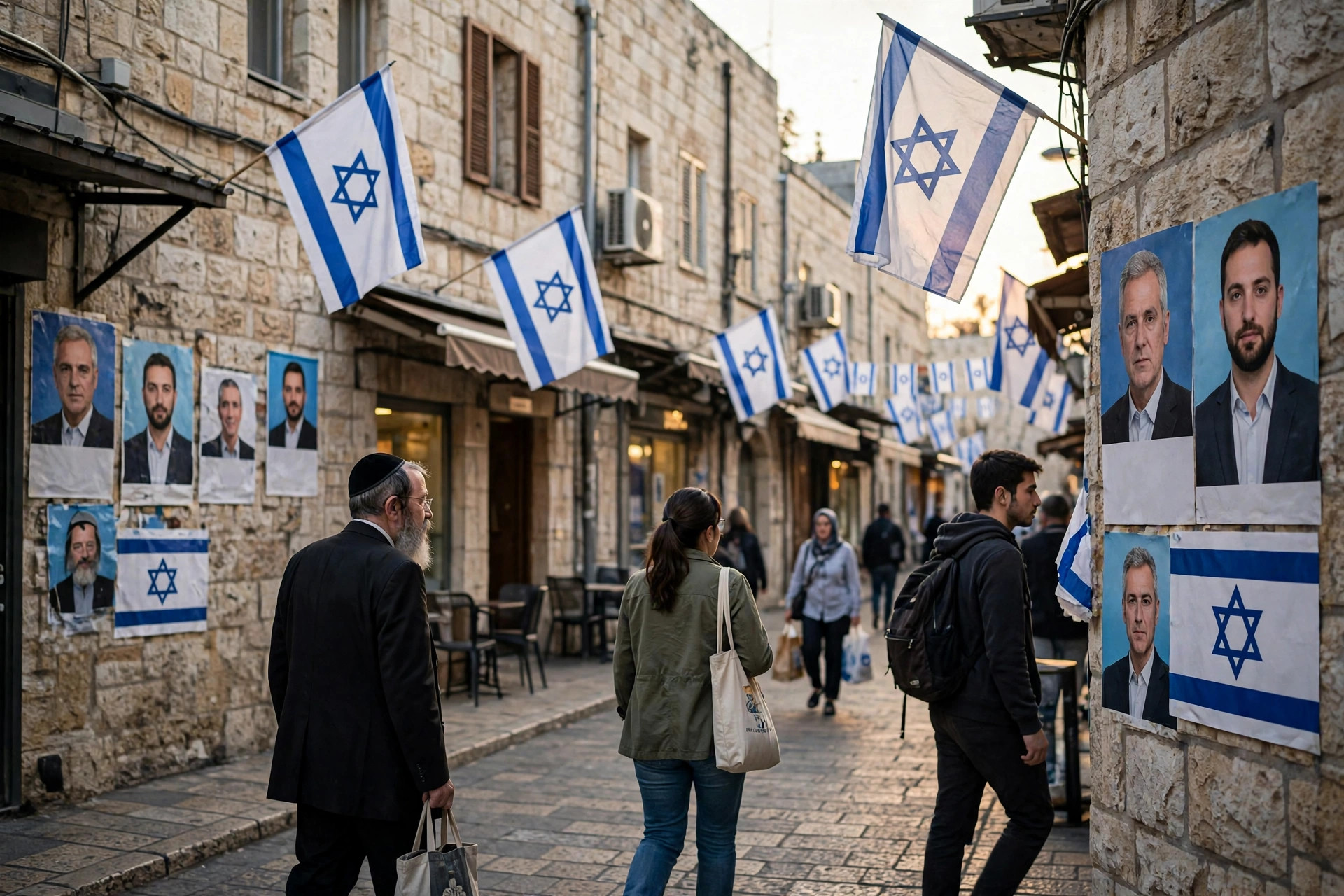 Editorial illustration — Press Pass USA
Israelis head to the polls Tuesday for a parliamentary election that final polls suggest will settle very little on its own: neither Prime Minister Benjamin Netanyahu's bloc nor the opposition is projected to win the 61 seats needed to form a government in the 120-seat Knesset.
Israelis vote for party lists, not individual candidates, and only lists clearing a 3.25% threshold win seats. Thirty-six parties are in play, with polls suggesting 11 to 13 will clear the bar. The two largest parties are Netanyahu's right-wing Likud and Yashar, a new centrist party led by Gadi Eisenkot, a former military chief of staff who has emerged as his principal challenger.
Polls diverge sharply on the details. The latest Channel 12 survey puts Eisenkot first with 23 seats, ahead of Likud with 21, while the pro-Netanyahu Channel 14 projects Likud at 30 seats and Eisenkot at about 20. Most polls put Netanyahu's bloc — Likud, two far-right parties and two ultra-Orthodox parties — at 49 to 55 seats, short of a majority. In head-to-head matchups on who is better suited to be prime minister, Eisenkot has led Netanyahu by a steady margin, CNN reported.
The opposition, which looks strong on paper, is deeply fragmented, CNN noted: Eisenkot has former Prime Minister Naftali Bennett and former Defense Minister Avigdor Liberman to his right and the Democrats party led by Yair Golan on his left, and Bennett and Liberman have not endorsed Eisenkot, each holding their own premiership ambitions.
That arithmetic could make Israel's Arab parties decisive. Nearly all polls ahead of Tuesday's vote put the parties aligned with Netanyahu and those aligned with Eisenkot at around 50 seats each, with Arab parties projected to take at least 13, the New York Post reported. The opposition has said it will not form alliances with the Joint List or Ra'am, but the Post noted that Arab turnout — among 2.1 million Israeli Arab citizens, about 20% of the population — is expected to be high. Coming out as the largest party is not enough to win: forming a government can take days, weeks or even months of coalition talks.
Sources: CNN (Oct 25, 2026); New York Post (Oct 26, 2026); final pre-election polls by Kan 11, Channel 12, Channel 13 and Channel 14.
Sponsored