
Supreme Court to hear Ohio case on praying at home without a permit
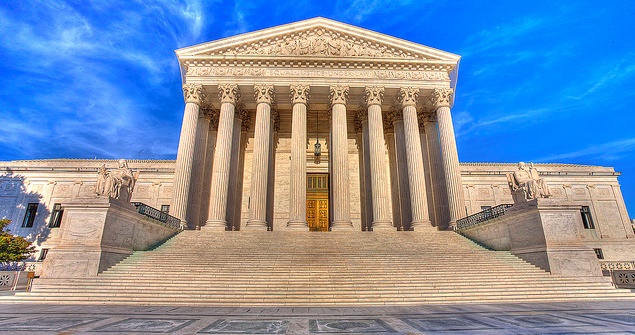 Photo: NYU (file photo)
The U.S. Supreme Court will hear arguments on Dec. 9 in a case that began when an Orthodox Jewish man in University Heights, Ohio, was told he needed a permit to pray with friends in his own home. The justices will decide whether he could take his religious freedom claims to federal court — or whether he first had to finish the city’s zoning process.
Daniel Grand invited about a dozen neighbors to his home in the Cleveland suburb in January 2021 for a Sabbath prayer gathering. His faith requires him to pray with a minyan, a quorum of at least 10 men, and Orthodox Jews do not drive on the Sabbath, so the nearest synagogue meant four round trips of roughly six miles on foot.
Before the group had met even once, the city sent Grand a cease-and-desist letter telling him to stop using his home as a “place of religious assembly” without a special-use permit, warning that violations could bring building code citations. Grand said then-Mayor Michael Dylan Brennan later told him: “You are under no circumstances allowed to have any type of religious gathering in your home without first obtaining a special-use permit.” Grand canceled the gathering.
Grand applied for the permit and appeared before the University Heights Planning Commission, then withdrew the application, saying he never intended to operate a formal house of worship in his home. “The problem wasn’t just that I had trouble getting the permit but that the city demanded I get one in the first place,” he wrote in a first-person account published by Alliance Defending Freedom, which now represents him before the Supreme Court along with Orrick, Herrington & Sutcliffe.
University Heights disputes Grand’s account. The city says its zoning laws do not prohibit small prayer groups in homes, and that Grand’s original invitation described the gathering as a “shul” and the inauguration of a “Beis Hakeneset,” or house of assembly — descriptions the city says raised the question of whether he intended to establish a formal house of worship subject to zoning rules.
Grand sued in federal court in 2022, arguing the city violated his First Amendment rights to free exercise, free speech and assembly, as well as the Religious Land Use and Institutionalized Persons Act. A federal district court dismissed the case, and the 6th U.S. Circuit Court of Appeals upheld that decision in November 2025, ruling his claims were not ripe for federal review because he withdrew his permit application before zoning officials reached a final decision.
The Supreme Court, which agreed to hear the case on June 30, is not being asked whether the city violated Grand’s religious liberty rights. Instead, the justices will decide the narrower question of whether a person whose prayer meeting was stopped by a city’s warning can sue right away, or must first complete the local zoning process. A decision is expected by the end of June 2027.
“No American needs a permit to pray,” said Alliance Defending Freedom Senior Counsel John Bursch, who is representing Grand. “If my next-door neighbor invited friends over for a weekly poker night or Book of the Month Club meeting, the city wouldn’t require a special permit,” Grand wrote. “They shouldn’t require one for a prayer meeting, either.”
The case has drawn broad support for Grand. The federal government has filed a brief backing him, along with 14 states, 51 members of Congress, the U.S. Conference of Catholic Bishops and the Becket Fund for Religious Liberty. U.S. Solicitor General John Sauer has been granted time to argue alongside Grand’s lawyers on Dec. 9.
One complication hangs over the hearing: Grand sold his University Heights home and moved outside the city in July. The city argues that makes the case moot, because he is no longer subject to its zoning ordinance. Grand’s lawyers say the case remains alive because he is seeking relief for injuries he says already occurred, including damages.
Religious groups on both sides are watching the case closely. The Southern Baptist Convention’s Ethics and Religious Liberty Commission joined the Catholic bishops in a friend-of-the-court brief supporting Grand, saying religious exercise “has never been confined to the church sanctuary” and that gathering in the home to pray, study Scripture and worship “is part of the ordinary practice of their faith.” Ahead of the hearing, Alliance Defending Freedom is running a nationwide #PrayFreely campaign, asking churches, Bible studies and prayer groups to pray for the case and to pray together on the morning of oral arguments.
Sources: The Christian Index (Henry Durand), “Supreme Court to hear religious liberty case over home prayer gathering” (Nov. 19, 2026, full text verified); Ballotpedia, “Grand v. City of University Heights” (argument Dec. 9, 2026, verified); U.S. Supreme Court docket No. 25-965 (verified); National Council of Jewish Women, “US Supreme Court 2026–2027: What’s at stake” (verified); The Center Square, via Liberty Bell Report (Solicitor General to argue Dec. 9, verified). Event date verified: oral arguments scheduled Wednesday, December 9, 2026.
Sponsored