
Spain votes Sunday in snap election that could end eight years of Socialist rule
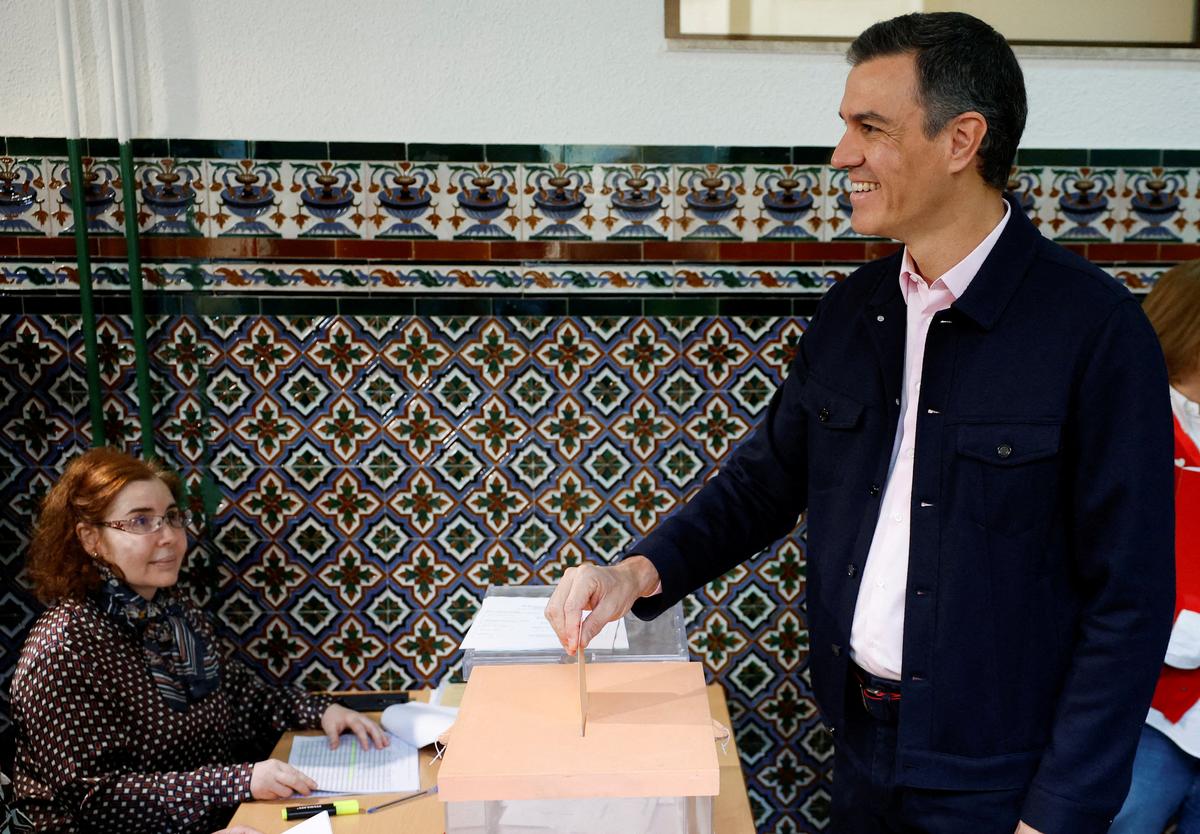 Photo: Reuters (file photo)
Spain votes on Sunday in a snap general election that could end eight years of Socialist-led government and bring the far right into the country’s national government for the first time since Spain returned to democracy.
Polls open at 9 a.m. local time (8 a.m. GMT) and close at 8 p.m., with the first provisional results expected about an hour later. All 350 seats in the lower house of parliament are up for election, along with 208 of the Senate’s 266 seats. Only the lower house chooses the prime minister.
Prime Minister Pedro Sánchez called the vote after parliament on October 2 rejected his decrees to address growing anger over rising rents and evictions. Sánchez, who has led the Socialist Party since 2017 and been prime minister since 2018, is already the second-longest-serving premier since Spain’s return to democracy in 1978.
Practically all opinion polls point to a potential coalition between the conservative People’s Party (PP) and far-right Vox as the only combination able to win an absolute majority. The PP is seen as the largest party at around 31% of the vote, while Vox stands at roughly 18%. Sánchez’s Socialist Party (PSOE) is mostly expected to come a close second at close to 30%, with parties further to the left jointly polling at around 10%.
The final published poll by 40dB for El País and Cadena SER put the PP at 127 to 136 seats, the PSOE at 116 to 127 and Vox at 51 to 61 — more than 190 seats between the PP and Vox, comfortably above the 176 needed for an absolute majority in the 350-seat Congress. The state-run CIS pollster was the outlier, putting the Socialists first. No new polls could be published after Monday under Spanish law.
The polls said much the same in 2023, when the PP and Vox finished with 170 seats and Sánchez won a new term 116 days after the vote. A PP-Vox coalition this time could give a far-right party a cabinet role for the first time since the death of dictator Francisco Franco in 1975. Vox leader Santiago Abascal, who co-founded the party in 2014, has built it into Spain’s third-largest party on promises of tougher immigration controls, lower taxes and the reversal of many progressive social policies.
The main party leaders closed their campaigns on Friday. Sánchez spoke at Madrid’s Caja Mágica, where the Socialist Party said more than 13,000 people attended, and asked voters for a “progressive majority.” PP leader Alberto Núñez Feijóo, 65, the former president of the region of Galicia who has led the PP since April 2022, closed in Seville alongside Andalusian regional president Juanma Moreno, with his party citing more than 9,000 attendees. Saturday is a legally mandated day of reflection, with no campaigning allowed.
Scarce, unaffordable housing has been arguably the hottest subject of the campaign, following nationwide protests over the eviction of an 87-year-old woman from her Madrid home. Sánchez favors rent caps and bans on short leases, while Feijóo is pushing deregulation, tax breaks for homebuyers and building more homes. Immigration has been another defining issue, with Sánchez one of Europe’s loudest advocates of immigration’s benefits for the economy and Vox demanding far tighter controls. Opposition parties also made corruption a central theme after convictions involving members of Sánchez’s inner circle and family, though they failed to tie Sánchez to the scandals; he has repeatedly denied any wrongdoing.
After the vote, the new lower house will meet on December 23 and elect a speaker. King Felipe will then nominate a candidate for prime minister, usually the leader of the most-voted party. The nominee needs an absolute majority of at least 176 seats in the investiture vote, or a simple majority in a second round. Coalition talks have no deadline, but a new government must be formed within two months of that vote to avoid another election.
Sources: Reuters, “Spain’s snap election — why it matters and who might win” (Nov. 26, 2026, full text verified); BBC News, “Spanish election: What you need to know and what’s at stake” (Nov. 26, 2026, updated Nov. 27, 2026). Event date verified: election Sunday, November 29, 2026; campaigns closed Friday, November 27, 2026.
Sponsored