
At least 64 dead as two high-speed trains collide in central Spain
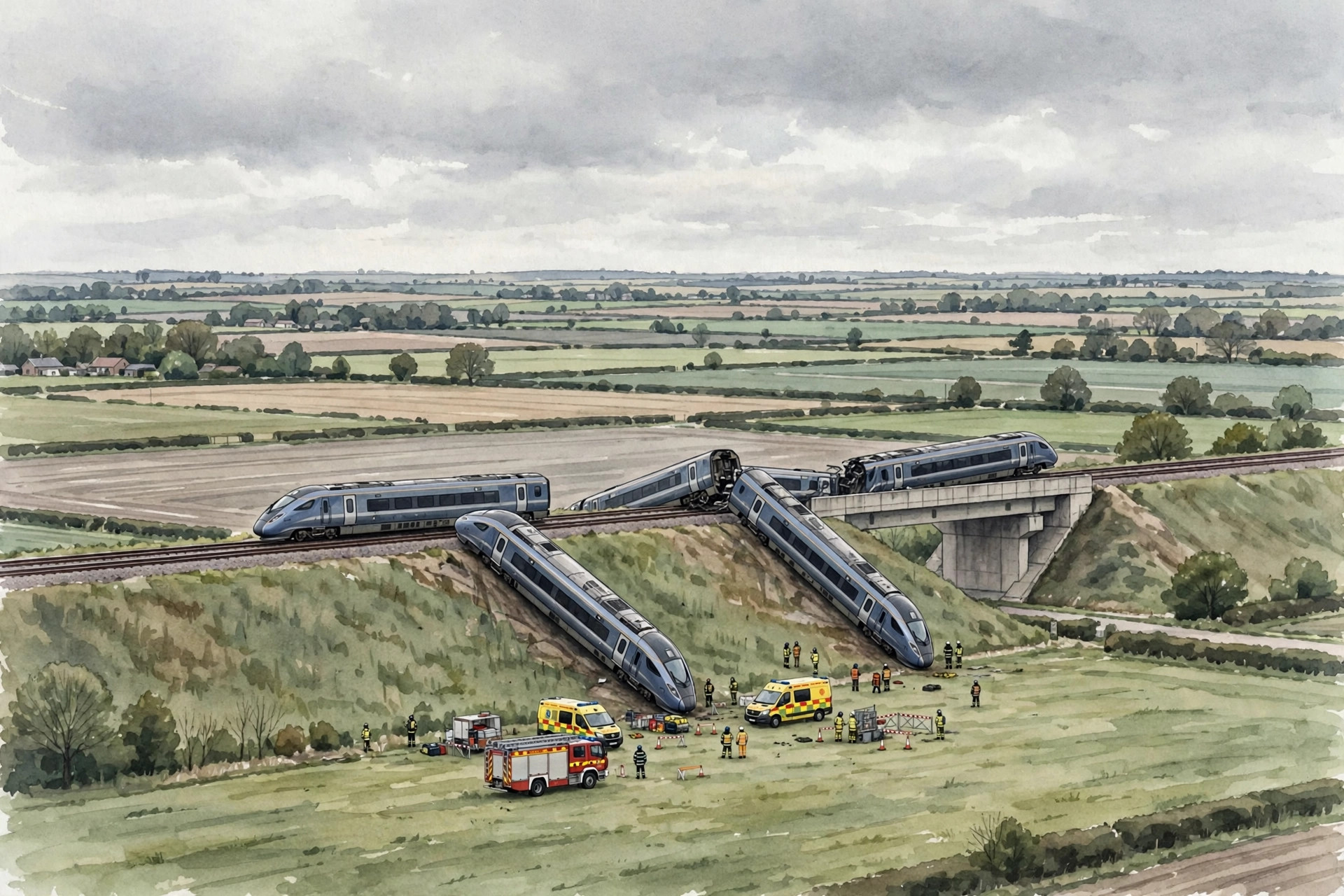 Editorial illustration — Press Pass USA
At least 64 people were killed and dozens injured Wednesday morning when two high-speed trains collided and derailed in central Spain, in one of the country's deadliest rail disasters in decades.
The rear-end crash happened at about 9:15 a.m. local time between the towns of Urda and Los Yébenes in Toledo province, on the high-speed line connecting Madrid to Seville. A Renfe train heading from Madrid to Seville ran into the tail of a stopped Iryo train traveling the same direction, knocking two cars off the track and sending wreckage down an embankment. The Associated Press reported 397 passengers were aboard the Renfe train and 147 aboard the Iryo train. The death toll rose through the day as rescuers worked through the two most damaged cars — authorities first reported 10 deaths, then at least 30, before officials put the toll at 64 or more, with dozens injured, some seriously.
Spain's transport minister, Óscar Puente, told reporters the wreck occurred after the Renfe train was authorized to continue its journey “despite an active red signal because of a stationary train on the tracks ahead, breaking protocol,” Reuters reported. Puente said the red signal was issued because of a computer communications failure that automatically stopped traffic, and “an erroneous decision” was made to restart the train. The rail operator Adif suspended service on the Madrid–Andalusia high-speed line, and Spain's football federation postponed all 24 Copa del Rey matches scheduled for Wednesday as a mark of respect.
Prime Minister Pedro Sánchez wrote on X that he was “shocked by the serious train accident in Toledo” and that emergency services were working on the ground to assist those affected. It was the second major train accident in Spain this year — and the second deadly crash involving trains from the same two operators on the same line, after a January collision near Adamuz in Córdoba province killed 46 people.
Sources: USA TODAY (Oct 28, 2026), citing Spanish officials and Reuters; Associated Press via NPR (Oct 28, 2026); Reuters (Oct 28, 2026).
Sponsored