
U.S. Catholic bishops approve new Mass lectionary, divest from private prisons at fall assembly
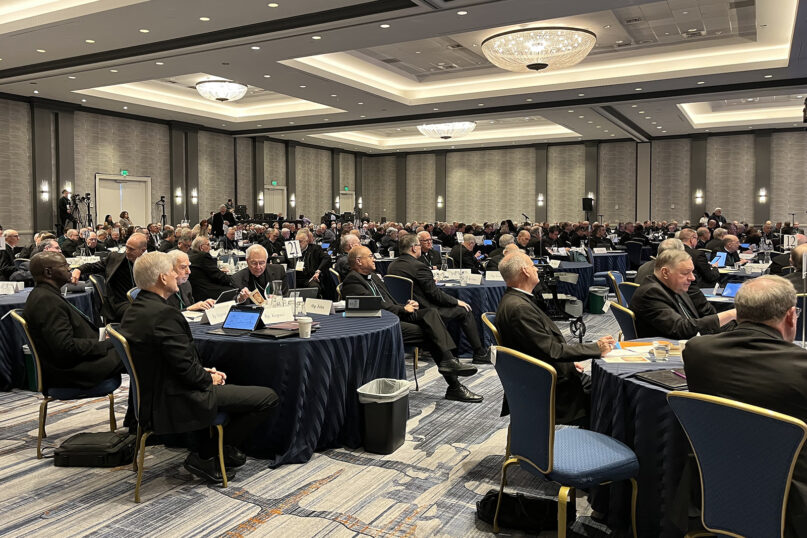 Photo: Aleja Hertzler-McCain / Religion News Service
The U.S. Catholic bishops wrapped up a sweeping set of votes at their fall assembly in Baltimore on Wednesday, approving a new Mass lectionary, barring investments in private prisons and certain artificial intelligence companies, establishing a day of prayer for racial justice, and agreeing to rewrite their pastoral plan on pro-life activities for the first time since 2001.
The votes came on the second day of public sessions at the fall general assembly of the U.S. Conference of Catholic Bishops, which met Nov. 16-19 at the Baltimore Marriott Waterfront.
The bishops voted overwhelmingly — 196 in favor, or 96 percent — to approve a new Mass lectionary and Book of the Gospels, with no amendments. The new readings will harmonize with the texts Catholics can read in the forthcoming Catholic American Bible. The bishops also approved a resolution on diocesan financial reporting through 2031.
They also voted overwhelmingly to update the conference's Socially Responsible Investment Guidelines, adding new prohibitions against investing in private prisons and detention facilities, and a new section limiting the kinds of artificial intelligence companies considered ethical enough for investment.
Under the updated guidelines, the bishops' conference may not invest in companies that build autonomous weapons systems or automated targeting systems for the military, security or immigration enforcement without meaningful human oversight. The rules also bar investment in companies that design AI to be addictive or manipulative, that harm the mental health of young or vulnerable people, that use AI for genetic manipulation or reproductive technology prohibited by Catholic doctrine, or that build surveillance technology that fails to prioritize human life and dignity, reinforces biases, or violates a person's reasonable expectation of privacy.
Beyond the divestment targets, the guidelines emphasize shareholder advocacy, drawing on the Vatican's 2022 document on Catholic principles for ethical investing, "Mensuram Bonam." Through that strategy, the bishops hope to push AI companies to prevent deepfakes and disinformation, block pornography, keep AI out of decisions about rationing health care or insurance claims, and promote privacy, workers' rights and environmental protection. The guidelines also raise concerns about cryptocurrency and prediction markets.
Bishop Oscar Cantú of San Jose, California, who chairs the bishops' new Task Force on Preserving Human Dignity in the Age of Artificial Intelligence, told his fellow bishops that the moment "represents a significant opportunity for the Church," comparing it to what the Church achieved after Pope Leo XIII's 1891 encyclical "Rerum Novarum" during industrialization. He cited Pope Leo XIV's 2026 teaching document on AI, "Magnifica Humanitas," and urged the bishops "not to fear the future, but to help shape it, with humanity at the center."
The bishops unanimously authorized — 205-0 — beginning work on a new pastoral plan on pro-life activities to replace the current one, which dates to 2001. Bishop Daniel E. Thomas of Toledo, Ohio, who chairs the Committee on Pro-Life Activities, said dramatic changes since then, including the overturning of Roe v. Wade, the widespread availability of abortion pills, new assisted suicide laws, the rise of in vitro fertilization and the Vatican's expanded teaching against the death penalty, demand a new plan.
Archbishop William E. Lori of Baltimore spoke in support of the update, and Archbishop Gabriele G. Caccia, the pope's ambassador to the United States, called for the revised plan to include advocacy for banning human surrogacy, which he described as a new form of trafficking worldwide and "another frontier" for the pro-life movement.
The bishops also voted 180-15, with seven abstentions, to designate the last Sunday in October as a day of prayer for racial justice. Bishop Daniel E. Garcia of Austin, Texas, who presented the proposal, said the observance would serve as a bridge between October, Respect Life Month, and November, which honors Black Catholics and Native American Catholics' heritage and history. He cited an Oct. 26 report from the Center for Applied Research in the Apostolate finding that 60 percent of adult Catholics in the U.S. believe racism exists in their local community, and about 4 in 10 say they have experienced racial discrimination.
Much of the day was devoted to listening. A panel of experts from The Catholic University of America presented research on young adults under 30, drawing on Gallup's 2026 Beauty and Belief survey, conducted in March and April. The findings: 64 percent of Catholic young adults say religion is more important to them now than it was five years ago, compared with 41 percent of Catholic adults over 30. The researchers said this generation identifies less as "spiritual" and more as "religious but not spiritual" than the older generation, reports a strong desire for community and moral guidance, and — while 58 percent of Catholics ages 18 to 29 are Hispanic — attends Mass weekly at a lower rate. Even so, the presenters told the bishops the Church is still "pretty far away in terms of revival."
On migration, Bishop Brendan J. Cahill of Joliet, Illinois, chair of the Committee on Migration, warned of a "culture of indifference" shaping the treatment of migrants in the U.S. and around the world. He criticized the government's "emphasis on mass detention and mass deportation" and the "sudden revocation of legal status and work authorization for millions of people," and described the challenges the Church faces in providing pastoral and sacramental ministry to Catholics in immigrant detention. He also noted substantial relief obtained for religious workers from overseas who serve the Church in the U.S., and pointed to the conference's Justice for Immigrants campaign, its "You Are Not Alone" initiative and the Cabrini Pledge, named for St. Frances Xavier Cabrini.
The bishops also heard from Auxiliary Bishop Richard Umbers of Sydney about the 2028 International Eucharistic Congress in Sydney, themed "This is my body given for you." Umbers said the congress has drawn heavily on the U.S. experience with the National Eucharistic Revival and the 10th National Eucharistic Congress, and that, at Pope Leo's request, it will place a special priority on young people.
Sources: OSV News via Catholic Courier, "Young adults, AI, migrants, racial justice round out bishops' meeting" (Nov. 19, 2026, full text verified); Religion News Service, "Catholic bishops vote to divest from private prisons, pass guidelines on AI investment" (Nov. 18, 2026, full text verified). Event date verified: the votes were taken Wednesday, November 18, 2026, at the U.S. Conference of Catholic Bishops' fall general assembly in Baltimore, Nov. 16-19, 2026.
Sponsored